
Orientation
Not quite a field guide
This is not a field guide in the strict sense of identifying species, though it will help you do that. It is a guide making a claim: that the exchange between a person and a forest runs in both directions continually, whether or not either party notices, and that you, dear reader, gardener, naturalist, forest explorer are as much inspected and worked upon as you might do to others. This guide asks you to stop treating “the forest” as a place you visit and observe from outside, and to start inhabiting it — a relationship you are already inside of, whether you have come alive to it in your mind or not. Your body is already in the forest, and already knows.
So this is the claim, a thesis of sorts. There is a conditioning at large which makes the forest an it, granting certain humans the right to treat a living entity as an object. That conditioning results in attitudes and behaviours. This guide rejects them, outright. Every part of seeing, knowing the land, discovering plants, gardening, expanding forest, and the gardener's own disposition — returns to some version of this same claim: the work changes the worker, seeing transforms the seer. This is often dismissed as sentiment. We reject that dismissal too, unless sentiment is understood in its original sense — rooted in the Latin sentire, to feel.
Now, as we — you, wherever you may be, alone or with others, and all of us here in this small land base, wherever you may be — begin, how do we meet?
Self and other, sensing, observing, feeling, speaking, tangling. Who guides?
Were we ever apart?
How this began
Around 45 years ago, Wolfgang's attention was caught by a strange plant growing on a piece of firewood in a pile he'd cut and stacked for his cooking, from fallen branches of trees. He vaguely noticed it stayed alive for weeks. It had strange pale green, almost silvery roots snaking along the bark. He had no idea that it was an orchid, or that it was an epiphyte. It was not the species, not the flower even, but just the fact of a plant growing on a plant, without soil, that caught his attention.
From this one epiphytic life form, which Wolfgang learned much later was an orchid, the long mission of the Gurukula Botanical Sanctuary was born.
After years alone in the Kerala woods, Wolfgang wasn't looking at it through any system. Nobody had planned it, least of all him. He knew, without ever having said it, that plants grow in soil, and this one did not. Seer and seen met in innocent strangeness, in the gap before any naming could step in. No laboratory, no scripture, no teacher. Science and religion both begin in a moment like this, and then grow: instruments and universities and research papers on one side, mantras, hymns, rituals, scriptures and lineages on the other. The larger they grow, the less they need anyone to be astonished. Wolfgang, in nothing but silence, stood where they started.
Now, in the age of AI, with everything known available at a prompt, that gap, where the unnamed can stay unnamed a while, is close to extinct. As custodians and beneficiaries of the Melkkadu, we can't give anyone what Wolfgang received, and we don't pretend to. No one can be made to feel astonishment. What we can do is keep the land open and the hours unclaimed: the wildest parts of the forest, stillness by the river, long stretches of listening, no prompt within reach, and no one seeking to tell a newcomer what they are seeing. They are free to go alone, or not to. Nobody is told what they saw; everyone is free to ask, and no one has to have something to say. Many days “nothing” happens.
What usually comes is affection. And appreciation, and beauty, unasked for.
To return to that little orchid: it spawned a biodiverse sanctuary. And yet, like most plants, orchids live in close partnership with mycorrhizal fungi, which thread through their roots and seeds and send out spores of their own. Perhaps Wolfgang breathed one in, the spore of a fungus or the seed of an orchid. His insight grew, nourished by tiny organisms. Something happened to his brain.
Likewise, we have all breathed in the Melkkadu, caught its contagion; its spores.
Does anyone wonder what, or who might be in our brains?
Our land
The Gurukula Botanical Sanctuary
Our 80 acres at GBS sit within a larger country. Within walking distance there are many habitats: the old forest, recovering forest, grassland becoming woodland, wetlands, bamboo brakes, gardens, stream edges and the Kallampuzha. The Sanctuary itself has become a kind of meeting place for plants from different parts of this region, especially plants whose original habitats have been damaged or destroyed.
A place that was grass becomes scrub. Scrub becomes young woodland. Young woodland grows into shade. Under that shade other plants appear, plants that could not have lived there before. The canopy rises and another world comes into being underneath it.
This is why the Sanctuary is the nucleus of this guide. Not because it contains the whole forest. It does not. Because here, in a small piece of land, we have been able to watch some of the processes of forest-making at close quarters.
What our hands knew first
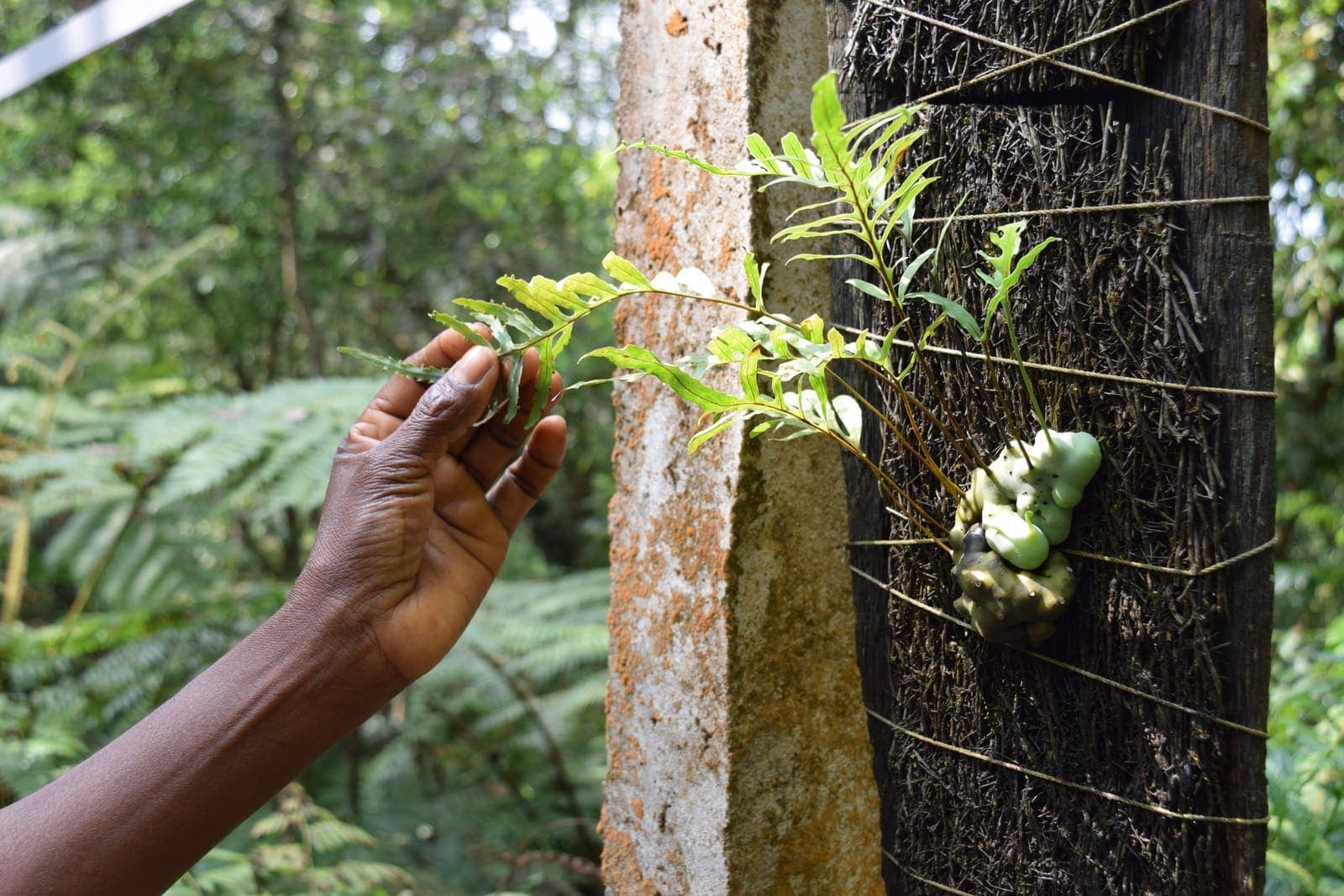
We've been walking this forest for many years, some of us for over forty or even fifty. Only now are we trying to write down what our bodies already know. Down here all the leaves, from trees to mosses, are cooler than our mammal skins. Our hands touch more plants than they do humans, except for small children. Our hands know plants. From brahmi patches on hill tops, to coarse kurunjis, and spiky edges of kolli, and the rough tubers of the kaatu kezhangu, we live among these green others. Have you felt the frail new fronds of chaava ferns? Have you eaten these?
But how it feels under the forest canopy, when you walk under the melkkadu, is that hint of unseen water all around you. It is cool because of water: the leaves, the stems, the roots move it. Have you noticed the difference between opening an umbrella for shade on a bright hot day, and standing under a tree? So we learn to trust our bodies, and they tell us the forest is alive. Your skin confirms this every time you meet a plant, long before you know its name.
The invitation
To walk with us beneath and between the leaves, and sometimes to look up through them. We will move between the things we know and the things we only suspect, between observation and wondering, between the names we need and the experience that comes before naming.
What have your hands touched today that you couldn't name?
On these words
Melkkadu is Jaimon's word, offered once in a group chat, half as a joke about what to call our exploration of our shade world. Melkkadu stuck. Try these words out. Mel, upper. Kadu, forest. Simple, Dravidian in the way it just states the relation and lets you do the rest. This kind of looking deserves its own name.
And then we went sideways, into English, and found the word canopy had nothing to do with layers at all when it started. It was a net. A bed-curtain. Something you hung over yourself while you slept, to keep the flies, mosquitoes and other biting insects off — kōnōps, the Greek word for mosquito, folded into conopeum, into canope, into the tree-shade we now stand under. We did not expect this mosquito net. We had built a whole thesis on canopy as an overhead thing, and the word itself corrected us before the forest did. Now we see canopies everywhere. Some kind of a layer formed by leaves and light. At the edge of fragmented forests, the tall kurinji shrubs and the small orchids, and Sonerilas, change the light quality, such that it feels like there is an inside and an outside. A side canopy.
If we could write in the myriad forest languages, and even the language of plants, we would. This is why we offer gardening as a way to learn about plants from plants. Rainforest gardening. It is intimate, and hand-borne. Touch is primary. Plants alter form when touched, and while touching, something shifts in us too.
A haptic language, each of us guiding the other, making a world together.
A second thread
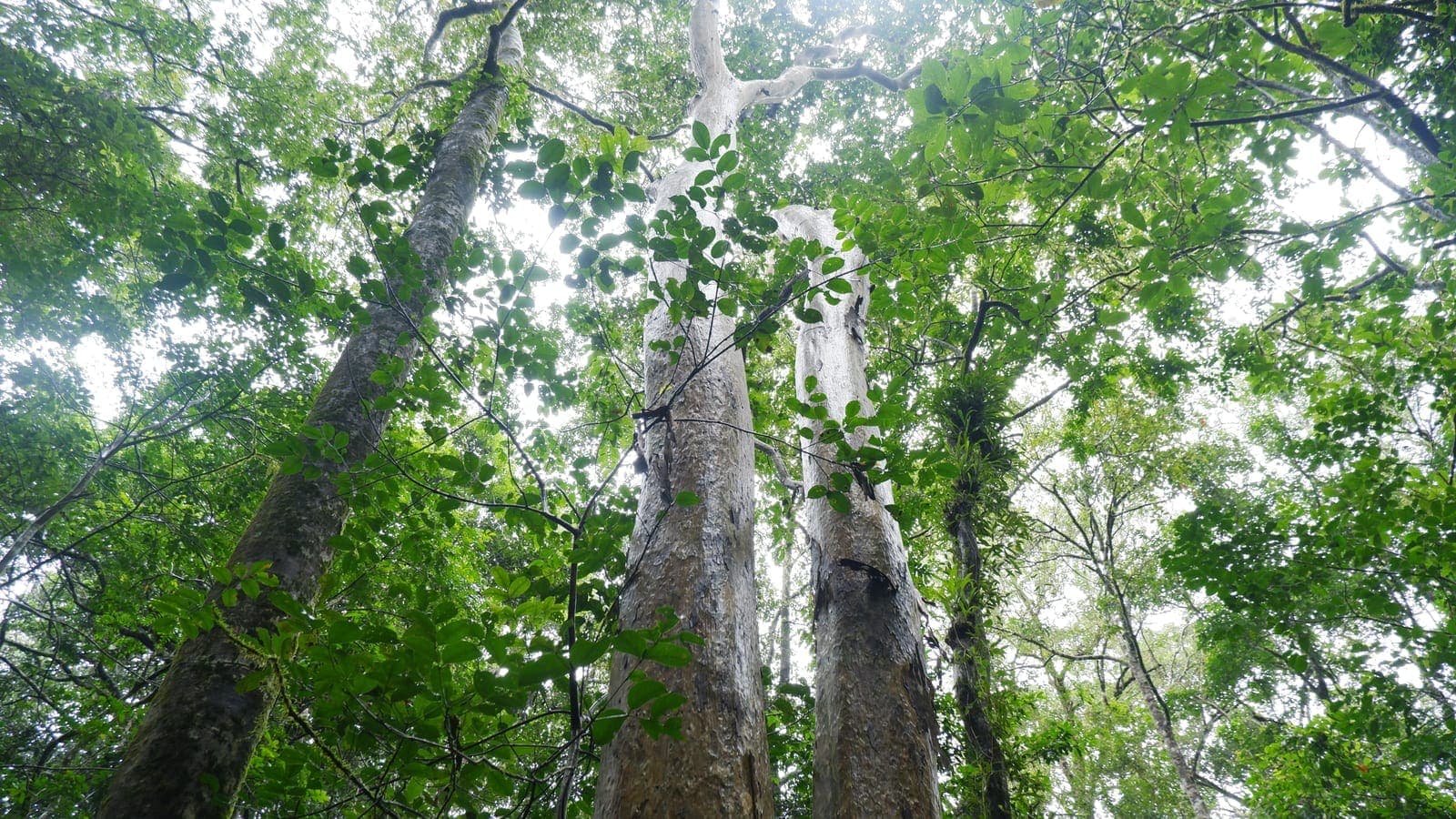
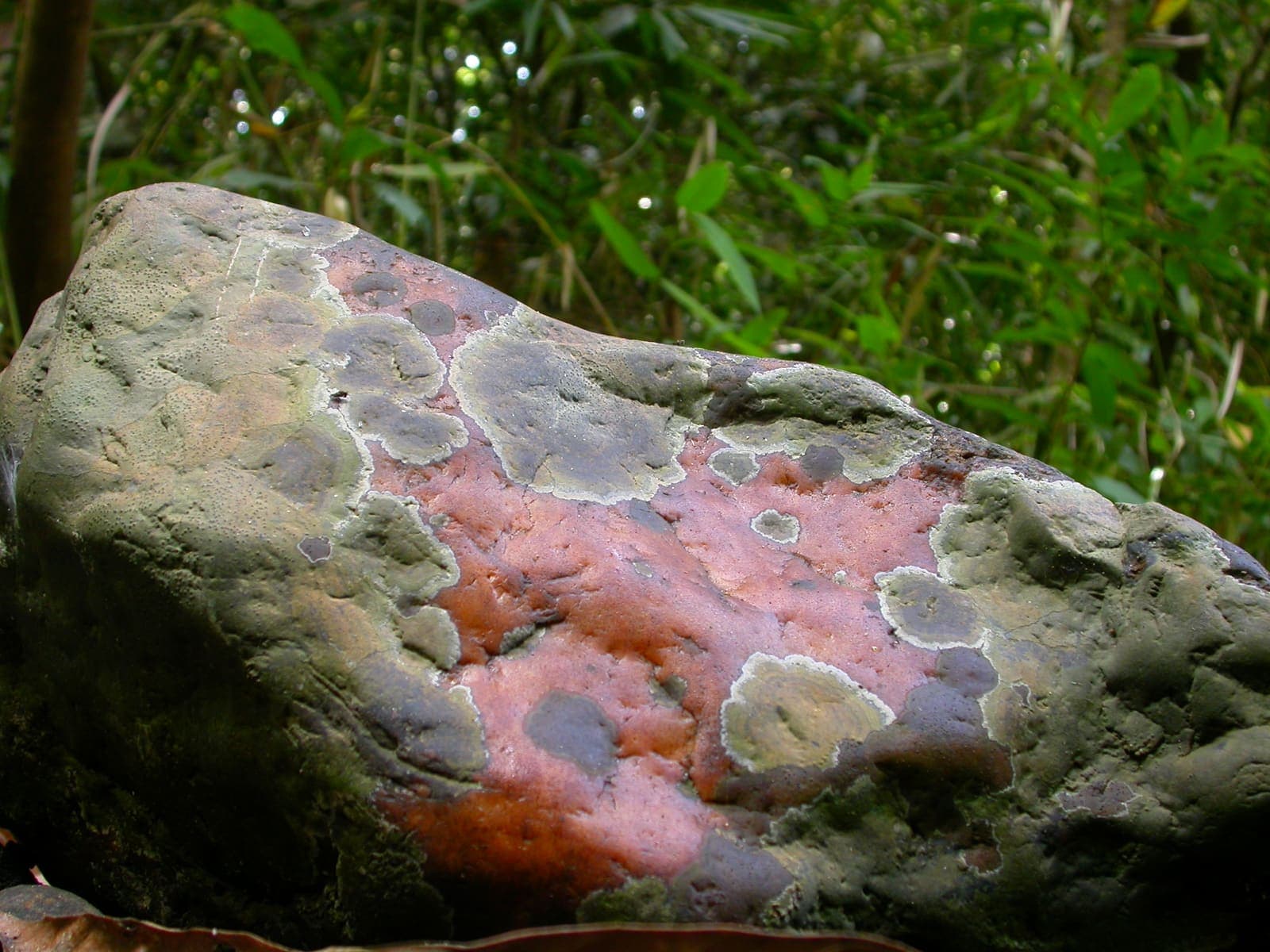
Here is something we keep circling back to, on every walk, at every scale: a canopy is a layer under which another layer of life exists. We tend to imagine it first as something high above us, the crowns of trees meeting and opening to the sky, but the more we walk and look closely, the less fixed the idea becomes. A single layer of lichen on a rock can be a canopy for bacteria living beneath it. Mosses only a few millimetres high, spread over soil, stone, bark or the roots of a tree, make a world for things smaller still. During the rains, tiny herbaceous plants appear on the banks, some with bright pink flowers and yellow stamens, sometimes with only five or six leaves. When hundreds grow together, each leaf casts a little shadow on another leaf and on the moss beneath. Even a fallen leaf becomes a temporary canopy, a roof under which a pill millipede or spider can shelter, while the leaf itself begins the long process of breaking down. The roof becomes food. The canopy becomes soil.
The rainforest is the most extravagant version of this layered world that we know here. From the crowns of trees thirty or forty metres above where we walk, and sometimes much higher in other forests, down through branches carrying epiphytes, vines and mosses, all the way to a filmy fern leaf pressed against a trunk, there are layers upon layers of life. We have chosen to look at the world under the leaves, but the more we look, the harder it is to say exactly where one layer ends and another begins. The forest is not made up of a few clearly defined storeys. It is a succession of overlapping worlds, each one making conditions for something else to live.
Where the Idea Breaks
A closed canopy overhead, on its own, does not tell us what we need to know. We learned this the hard way, walking into a plantation stand that had been strimmed one morning in the late monsoon. The trees were still there. The shade from the canopy still formed, albeit sparsely. And the ground underneath was dry, under all that green. Someone had taken the herbs, the grasses, the low climbers off the understorey, the adi kaadu — because neighbours were afraid of the dark, feral vegetation, said to harbour wildlife, and its shade, said to be destroying their home gardens.
The overhead layer blocks the sun — while everything else we'd been calling forest, or young forest, or rewilding land — the coolness, the held moisture, the slow exchange of air across a thousand wet surfaces — depends on far more layers than that. It means the shade dependence of tender plants is one thing, but their own presence, and the layers they make is another thing. It's a whole vertical community, top to litter, and if you break this, in the way you break habitat horizontally through clearcuts, mining, and burning, you lose precious qualities that a forest needs to grow itself.
On beholding and belonging: tracing species and Inam
If you've come to this page, sit a moment with the most important word in any field guide — species. Have you wondered how you came to use it so easily? We assume it is neutral.
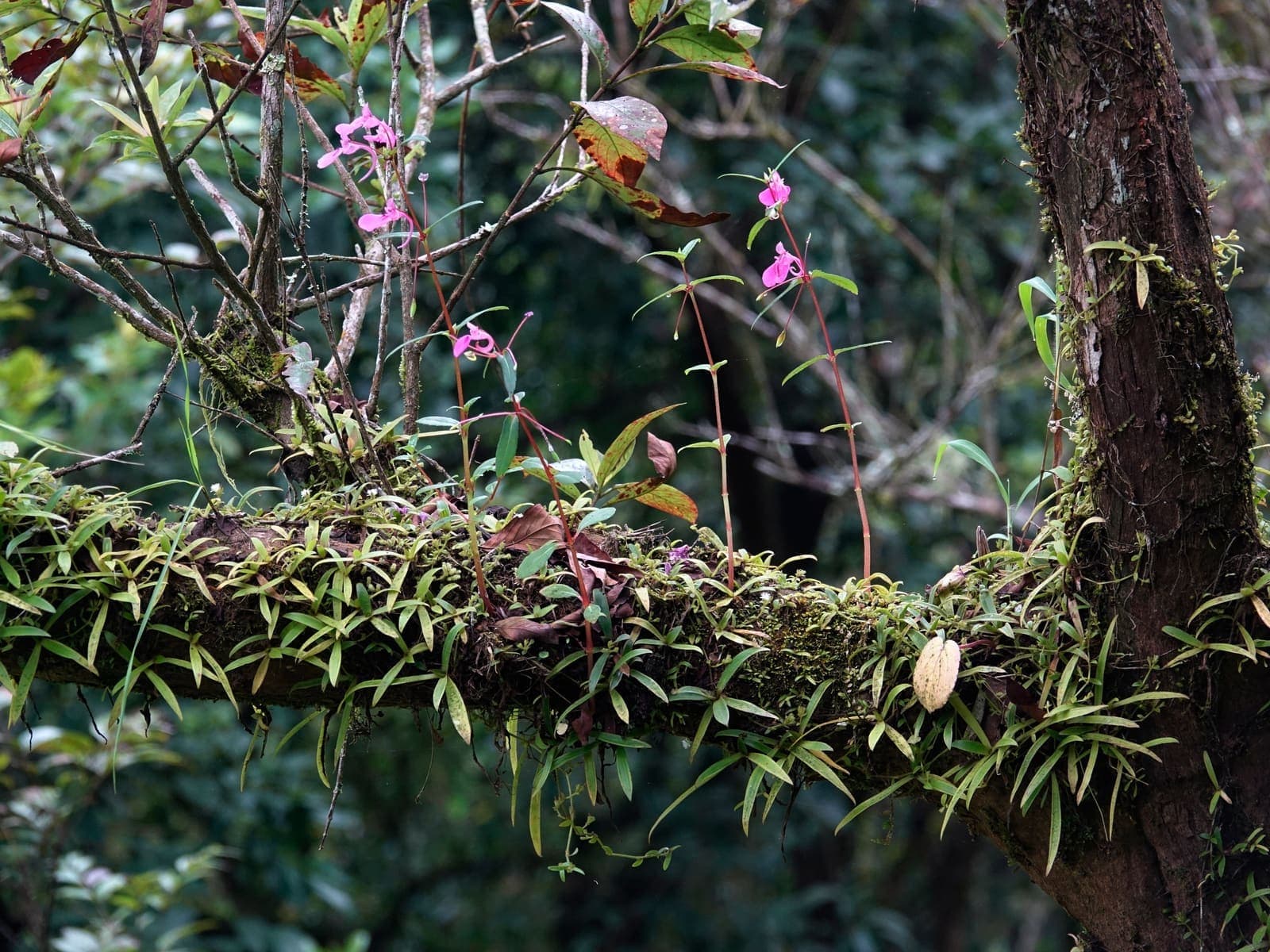
Go back far enough and the word is a verb. Specere, to look, to behold. Someone standing by a bright flowered epiphytic plant on a tree, a beautiful balsam on a tipetti tree. A plant on another plant; and they see its backlit crimson flowers jiggling in the late monsoon rain. They see this before the name leaps on their tongue: Impatiens jerdoniae. An act of attention coalesces into identification.
That's the quiet theft at the center of the word species: it began as an act of attention and ended as a reason to stop attending.
Can we bring back the deeper sense of beholding? In attention is awe. If you are not in awe, you are not attending.
In Tamil, the word is iṉam. இனம். Open the old Lexicon and the first sense is what you'd guess — class, kind, species, sort. But it doesn't stop there. Second sense: race, clan, tribe. Third: comrades, friends and associates. Fourth: brotherhood, fellowship, company. Fifth — pack, herd. And folded in near the bottom: equal. Peer.
Latin stands a little at a distance from the flower and asks: what do I see when I look at it? Tamil stands inside the relationship and asks: who dwells beside it? Who does it belong with? One word was built by a spectator, speculating. The other was built by someone already among the company, relating with who else is there.
Neither is the truth. Neither is the mistake.
Iṉam doesn't require the thing to stop moving before it can be spoken of. It just asks who it's traveling with. It's a company you keep — and company, unlike a spec sheet, is convivial, and doesn't require a decision.
But we can carry the other question underneath, as we walk — not only what does this look like, but who does it live alongside, who is it kin to, which herd is it never really apart from — the ironwood vayanavu by the dark pool, eerullamkuzhi, upstream from the confluence koodal, known the way you know a person. By where they live and what they do and who lives next to whom. Not things in boxes.
Hold both. The looking and the belonging. From attention comes a seeing. Notice what changes in you when you find belonging.
Geographic and ecological scope
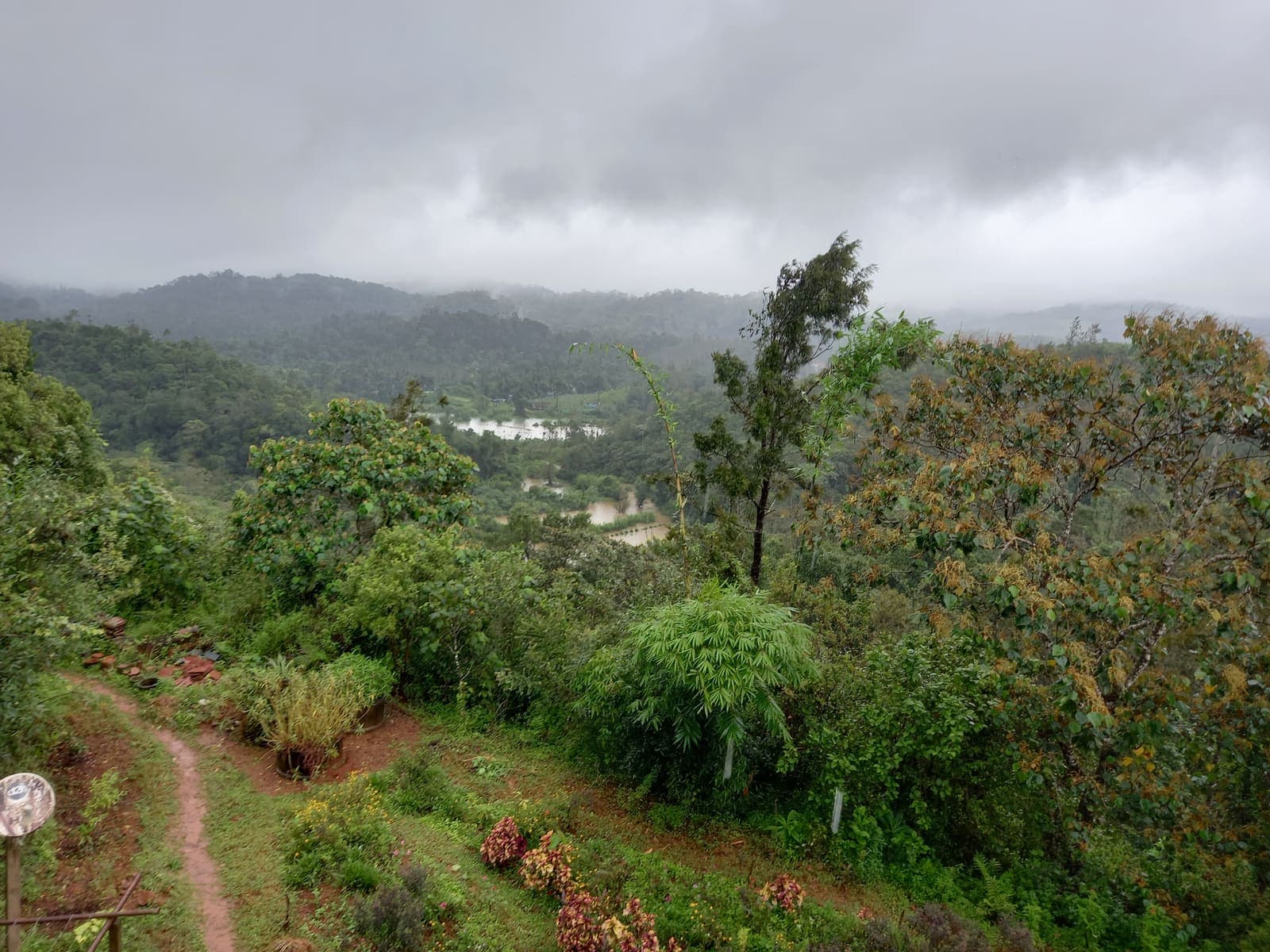
This guide begins here, at the 80 acres of the Gurukula Botanical Sanctuary, but its ambit is larger. A distance of perhaps 16 kms radius is familiar terrain for all of us. We protect this length of the Kallampuzha stream, and walk the Peria Reserve Forest, and know the hamlets and villages from Peria to Alattil and Kunjome.
For the Melkkadu project we chose a larger area, from Makuta in Coorg to through western Wayanad to the southern rim of the Camels Hump mountains, and then around the south western edge of the Nilgiris, where we have another perch, the Thiriyannara Refuge. About 10 acres of land near Korakundah.
The southwest monsoon comes in from the Arabian Sea and meets these mountains. It climbs them. It breaks itself against them. It becomes cloud and mist and rain. The wet forests are not simply forests that happen to receive rain. They are forests made by this encounter between mountain and monsoon, and by all the beings that have lived within it for a very long time.
And yet there is no single line where one thing ends and another begins and especially in these times, when the conditions on earth and in every place are changing. This is what interests us.
Perhaps this is what a geographical scope ought to be: not a line enclosing a territory, but a way of learning where one place touches another.We want to understand how plants make place. Once we see what they do, perhaps we can recognize their actions elsewhere, their world-making, place-making agency.
A field guide usually tells you where to look for a specific plant. We would like this one to help you notice where the plant is living, what kind of place it has entered, what is above it and beneath it, what kind of forest might be forming around it, who makes its community.
Once you learn to see the forest in this way, a habitat is no longer simply a place on a map. It becomes something you can enter.
And perhaps, in entering it, you become part of it.
Deep time, held lightly
Before these trees, and the ancestors of these trees, there were lycopods here, or something like here — the ground this forest stands on was three hundred million years and half a hemisphere away from where it is now, drifting north out of a cold south while Gondwana and Pangaea were still one continent holding it. We try to keep this at the back of our minds on every walk and mostly fail, because the forest in front of us insists on being here and now. Life, all life, exists in the present tense. But it is worth saying plainly: woodiness is old. Leafiness is old. The species standing here now are almost certainly not the species that stood here when the ground itself first arrived, and we don't actually know whether there were proto-rainforests in this precise region before the land juddered into mountainhood at all — we've asked people who know more than we do, and the honest answer, so far, is that nobody's sure. Let's leave it unresolved for now. But the point is this: forests, trees, vegetal beings doing their thing — probing, exploring, perceiving new opportunities in their own version of a brave new world — and plant communities moving, becoming, changing, journeying, are as old as life on land.
Philosophical approach: reciprocity and ecological turnarounds
Every time we water the plants in the garden, we watch how they respond, or fail to, and we can sense something similar in our own bodies: heat, dryness. Now turn these questions around. Am I thirsty? Am I seeking water? What is my source? Can I do without it? Is the government helping me by giving me water every day, piped in from a river or a reservoir? Can I catch my own, without the government's intervention?
These are turnaround questions. The reversal is a device, and it should lead to a change of position. We are no longer only the ones who water, plant and prune, but also the ones who are watered, planted and pruned.
They are much more interesting while walking in a forest, or on land where we want to change something. Here a turnaround would ask: who else wants to plant here? Am I being planted here? Tending roots us. Am I seeding a thought? Cutting out a part of myself? Am I a shelter? Do I need one? What of my actions need I prune, or of my behaviours?
Held together
We act, while also being acted upon. We perceive, while also being perceived. We tend, while also being sustained. We change places, while places change us. Nor do we dissolve the distinction between human and non-human life.
The centre
We can look at a forest and still place ourselves at its centre. An ecological turnaround begins more carefully. It is not a matter of imagining what another being might be thinking or feeling, nor of simply reversing the direction of the gaze: I see the bug; perhaps the bug sees me. Both leave us at the centre.
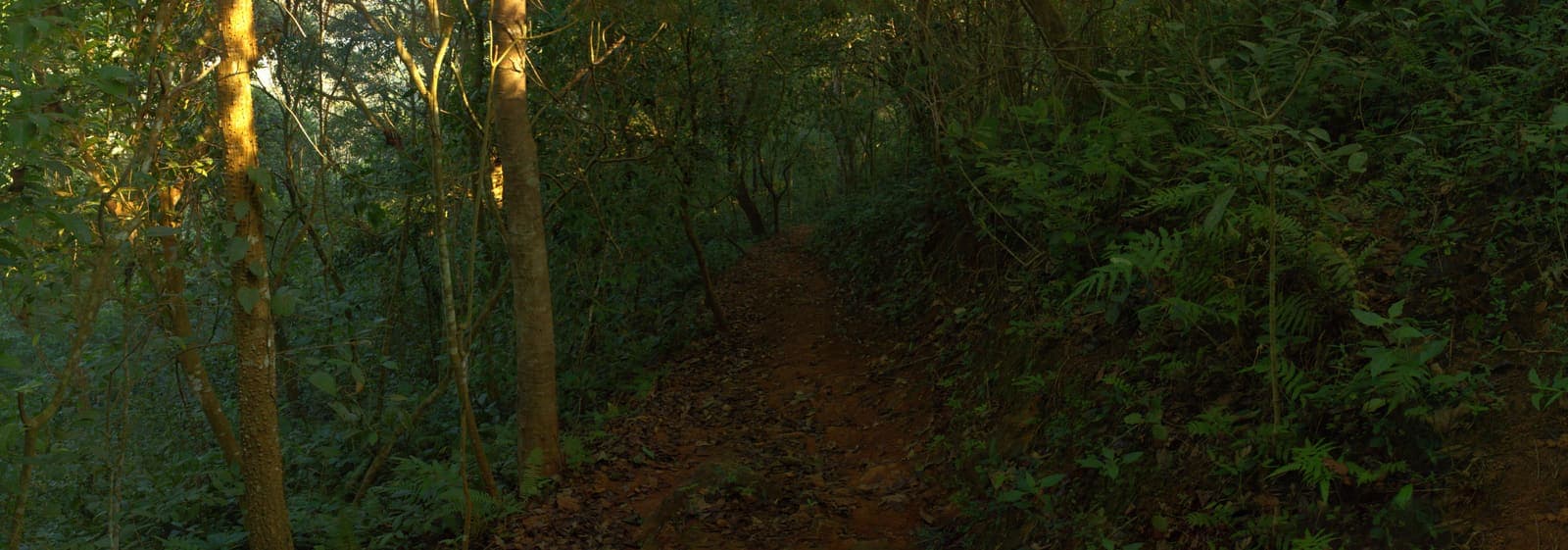
Instead, we notice the act of perception itself, and then attend closely to what is actually happening. A tendril unfurls. I do not need to imagine what the tendril is thinking. I can simply attend to its movement, and to the conditions through which that movement takes place. Then I begin to notice my own movement through space. Who else is sensitive to my movements? How?
From observer to participant
This matters because the distinction between observer and participant is not merely a philosophical problem. If I imagine myself as the gardener and the forest as my object, then restoration becomes something I do to a place. The turnaround asks us to look again at that arrangement. The forest is already active. When we enter this field with a thoomba (the long-handled spade of Wayanad), a seedling, a plan or a particular intention, our action becomes one more event within an ecology of actions and responses. This does not make our actions insignificant. It makes them situated. We can therefore ask: What happens when I do this here?
The aim is not to become passive. It is to become more precise about our place within a living system. Before asking what should I do?, it can be useful to notice where I am standing in relation to what I am about to do.
On we
Njangal. Nammal.
Malayalam has two words where English has one. Njangal is we without you. Nammal is we with you in it: the speakers, the listener, everyone within earshot.
English can't say the difference. It has one we. And we have to decide each time who is inside. Mostly, in this guide, when we is used, it is nammal. The reader is inside. So are the woodpecker, the meen-mutti, the leech on the ankle. So are all the humans in the melkkadu.
Nammal doesn't mean we agree. We come from different tongues, and different relations to this land: some of us born to it, some of us arrived on it. Nor does nammal blanket what is unequal among us: who of us owns land, who was born owning nothing on it, yet belonging, who can leave when the monsoon turns hard, and who cannot. Inequality doesn't disappear into a pronoun. It sits inside it, in the tangle.
What nammal refuses is narrower. The picture of an I over here, observing, and a forest over there, being observed.
And they? They is the pronoun issued from the one apart. Avar, athu. It. This is how the Latin binomial refers to the balsam on the tipetti tree. We try not to use these for beings whose company we keep.
Who is looped into the tangle of we and who not?
Who walks under the Melkkadu?
We leave it to the reader, the user of this guide, to unravel our voices and sift through our pointings. Here's Saji, climbing trees over thirty metres tall, in search of plants, or honey. A body built from fifty years of climbing, and of a people still of this forest, even if everything tears them away from it. Saji taking children, youngsters, up the strangler fig inside the Periya forest. Saji learning to photograph the world of his people, of his ancestors, and also of his own interest.
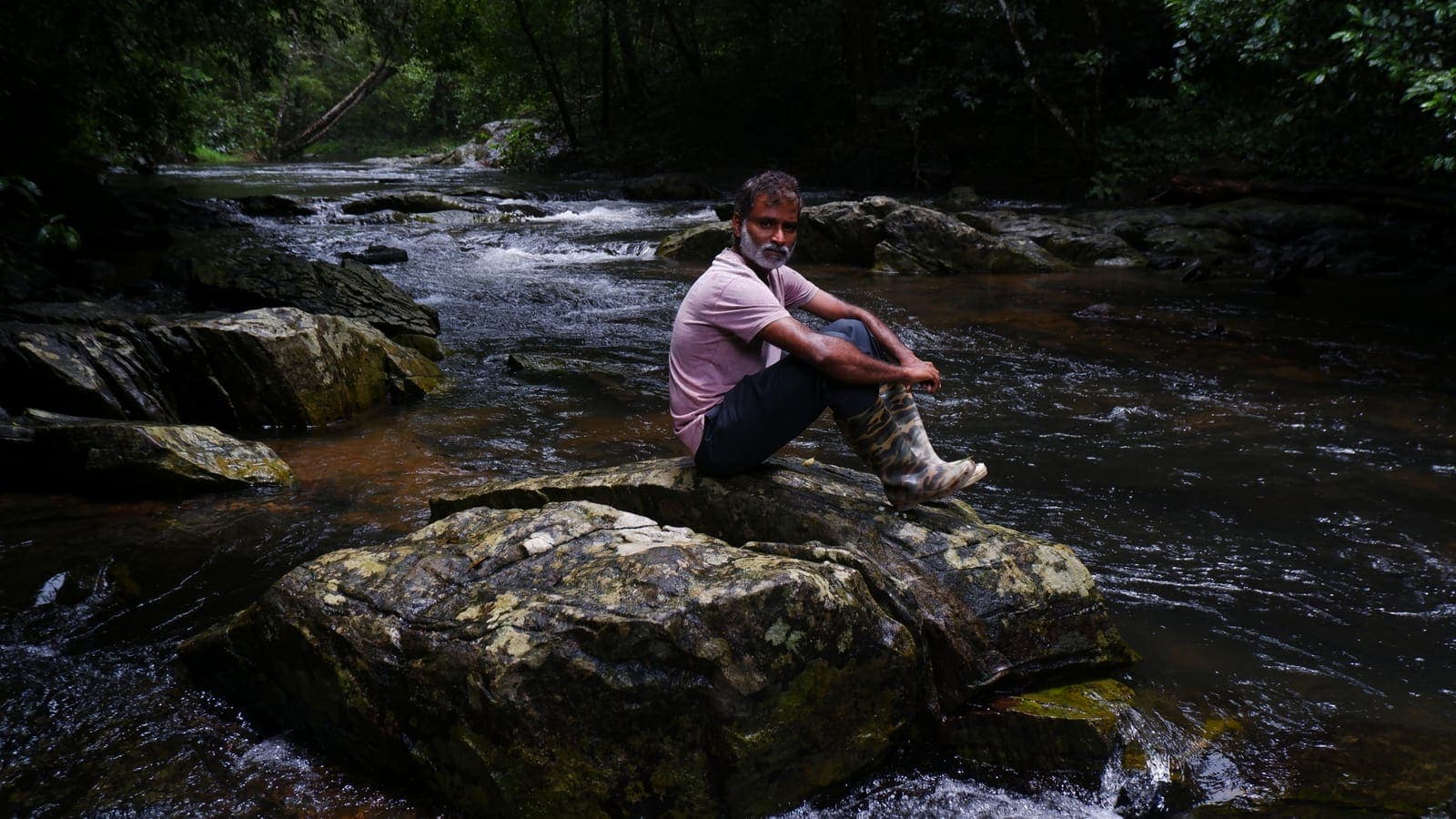
Here's Jaimon, fighting for the little stream that flows out of this forest, the Kallampuzha, taking groups upon groups to clean it of poison and trash, so all may drink its sweet water, and people might fish for happy fish who have darted in its cool, shaded waters coursing through bamboo reeds and tall trees still standing — millennia now, that this has been a forest.
Here's Guru, fallen into the tangling embrace of this lush world, in thrall of its tender plants, its tall trees, and its myriad creatures — writing, photographing, learning scientific and vernacular names, eyes turned skyward, canopy-ward, hands tending little plants in the rainforest garden at the edge of the forest.
Here's Fazal, his father once a ranger of this same forest. Fazal too drawn here by some feeling-sense for this diverse, tangling domain, his eyes and heart and hands rendering its magic for others. This website, the exquisite poster, are his imagination run riot.
Here's Pradeep, a farmer turned forest guardian, teaching and learning, and walking as he tends the lands he has grown up in, this part of the Wayanad forest.
Here's Shyamal, bug man, web master. Years of slow walks, at the rate of 100 metres over 4 hours, unravelling the tiny lives of arthropods for the rest of us. His alter-ego lives in Wikipedia, and thanks to Shyamal, we now have a "place" to store our queries and observations on a Melkkadu docuwiki.
One sweet line for Rahul, whose popups have made our poster interactive and fun, timely contribution to a long and complex project.
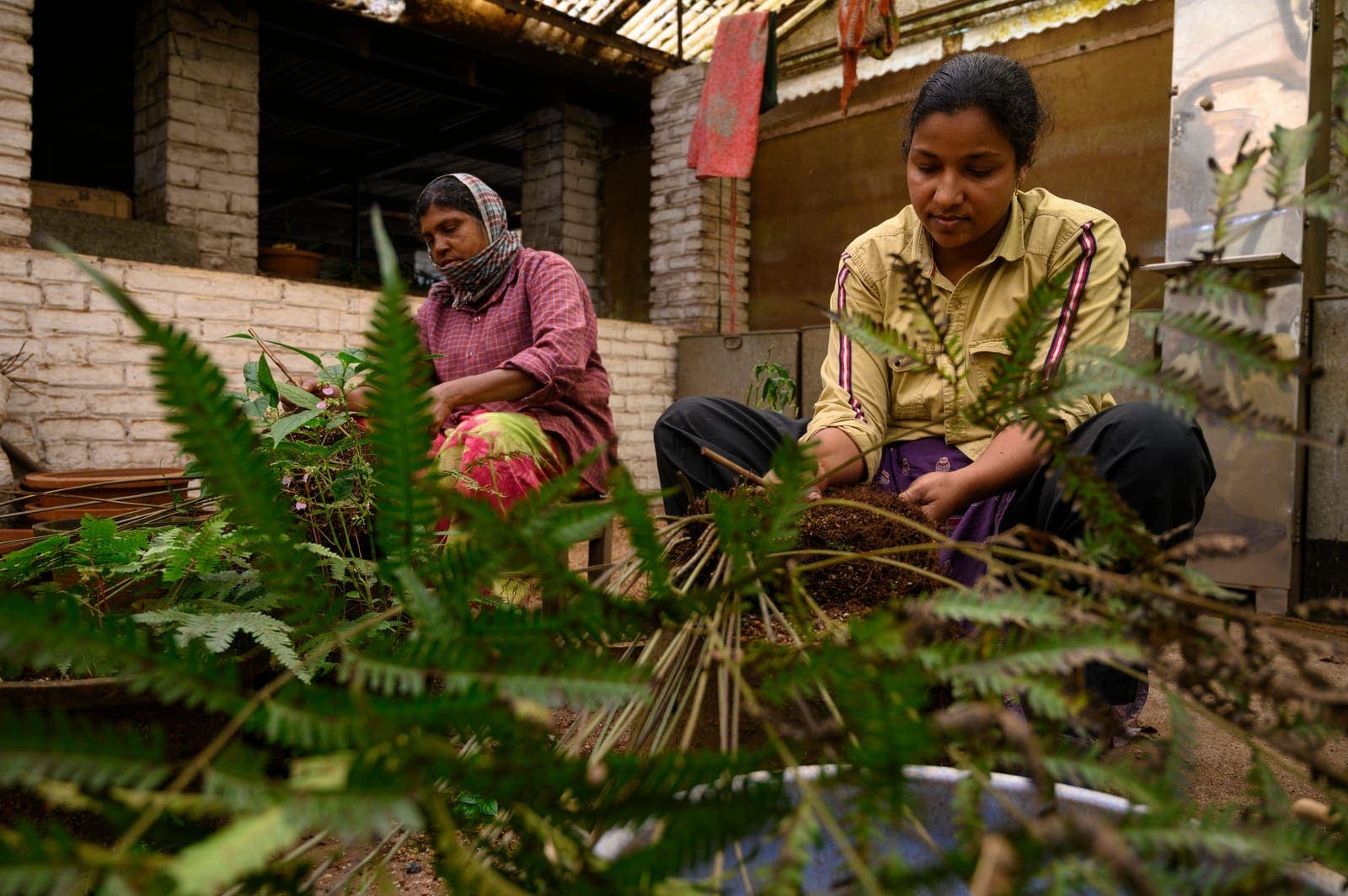
And here are Laly, and Seena, and Sini, and Lakshmi, Jessy and Sujatha and Sreeja, and Beena and Usha, and Anu and Rosly and Ragisha - whose hands and minds and love and care, have made this a plant refuge extraordinaire. Because of gardeners, the emphasis on hands and care, because of how we tend the rainforest. Each of them needs a book to themselves, and the special plants they are tangled with.
And as we come to the end of this round of acknowledgments, here are the joyous winter contributors, the students and teachers of Marudam Farm School, whose enthusiastic walks and tree studies with Saji and Pradeep, over many years, have given us a clearer understanding of all the magnificient trees, and also birds of this land.
Penultimately, Supi — three decades here, protecting through words, acting through words, and walks. Every walk an act of defiance and love, and every word too. The magic, that words too can expand forests. Come, see.
And Wolfgang, who started it all, a life under these trees, and a life with these plants, a human owned completely by these green others.